Indeed AI Sourcing Assistant
I shipped Indeed's first autonomous AI sourcing agent from zero to GA in eight months.
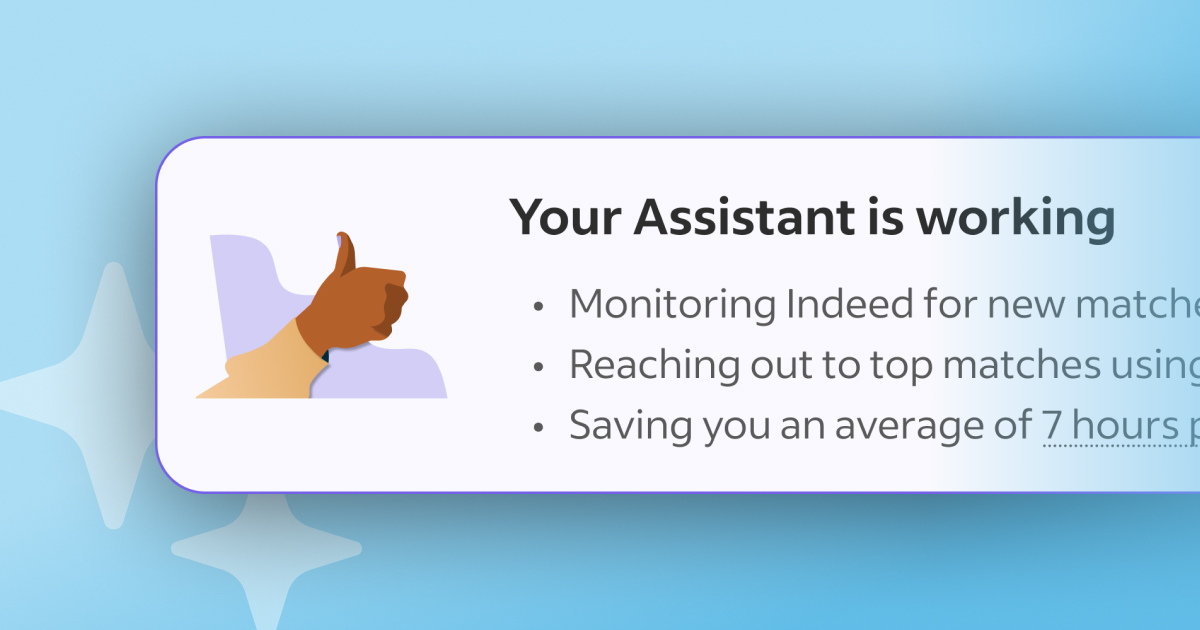
Background: Pivot to agents
Indeed's new CEO arrived in June 2025 with a directive for R&D to ship agentic products for sourcing and screening, the two most time intensive hiring tasks. Proactive sourcing improves hiring outcomes, but most employers don't have the time or the skills to source regularly. An agent that did that work for them could change lives.
I joined the new AI Sourcing team in June 2025 as Indeed reorganized around the new mandate. We kicked off the Sourcing Assistant program in August 2025.
Assignment: Autonomous or don't bother
Product leadership gave us the definition of success: a sourcing agent must invite candidates on its own. Anything else would be a faster horse. That kind of autonomy would require solving three problems:
- Intent: Ensure the agent knows what the employer wants in a candidate.
- Consent: Start with automatic outreach turned off and get explicit agreement to act.
- Visibility: Show the work the agent did when customers weren't looking.
My job was to define an experience that drove both agent activation rates and match quality.
"Chad is an amazing designer and his work is where enabled sourcing assistant to launch successfully (and change the revenue trajectory of that part of the business). Any company would be extremely lucky to have him." — Vice President (via LinkedIn)
Challenge: Activation versus match quality
We launched a white glove service (no interface) with 12 pilot customers, every function on the team working like a customer rep and recruiter. This phase let us stand up our core technology while learning the problem space:
- Job descriptions don't convey the true hiring intent. They're advertisements, not recruiting briefs. We learned to throw out the compulsory noise (like nice-to-have skills) while asking about unwritten domain details. For example, how do commercial and residential property manager resumes differ?
- Software can't mimic the recruiting intake conversation. Our team captured a productive protocol for getting clear hiring intent, but it required a human actively listening, following up, and probing. That protocol in a Gemini Gem produced promising results in research, but we found users were less willing to give Indeed's chat that same attention.
- Customers don't come to Indeed to do more work. Thinking is hard. Without humans easing the load, pilot users squirmed away from the setup process.
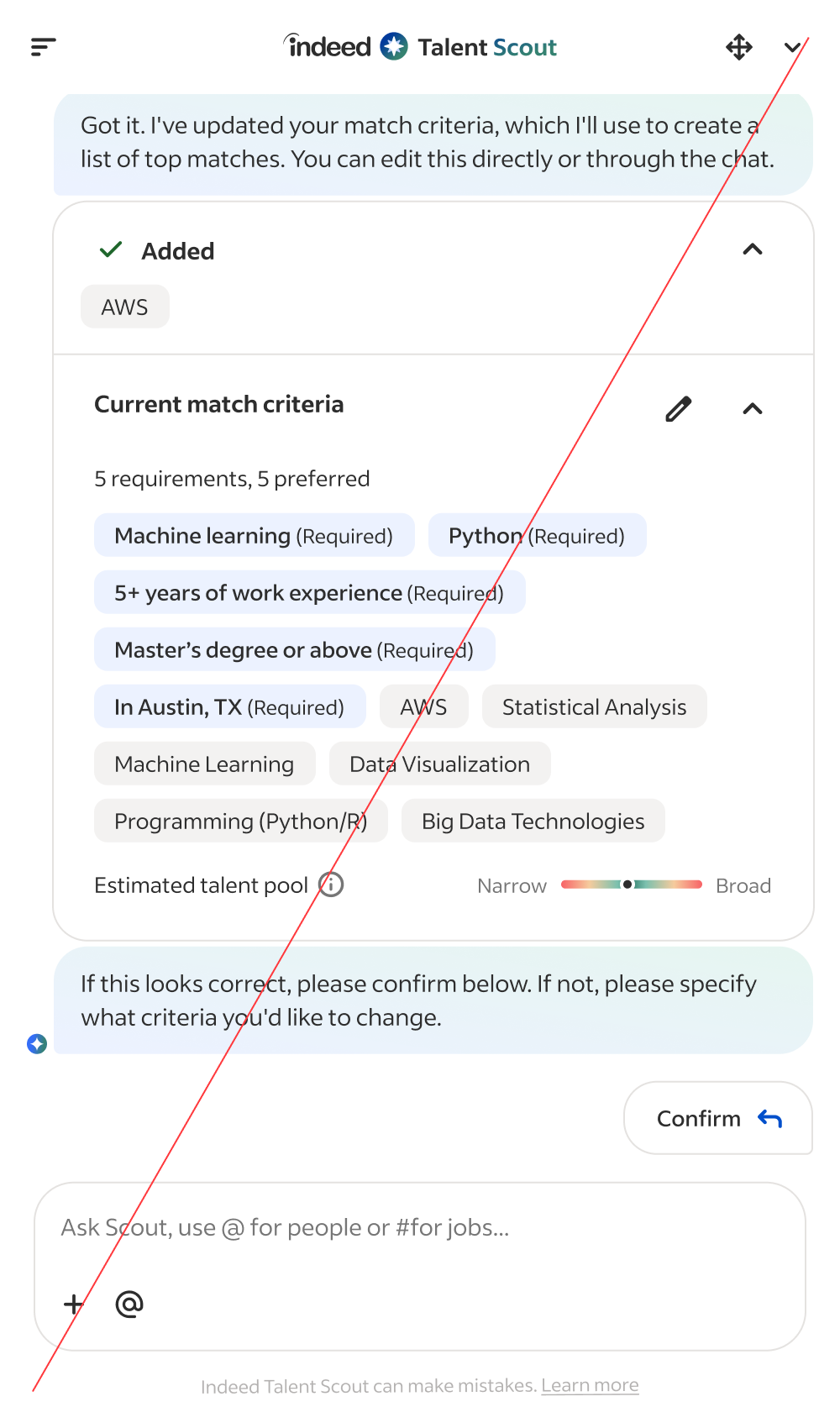
There was the tension. Every question we asked made the matches better, and made people want to close the browser. Activation and match quality were at odds. With the agent off by default, we had to earn activation.
Method: Finding good friction
Our pilot convinced me that our agent needed to be an opinionated tool, not a do-anything chatbot. I worked from these principles:
- Put users on a guided activation path.
- Infer first. Ask later.
- Provide low friction tools to correct agent understanding.
- Correlate all user work to hiring progress.
Working on a team of 60, we shipped and observed directly in production with a controlled cohort of real customers.
Intent collection: removing bad friction
To capture hiring intent, we introduced the concept of assistant instructions, a hiring brief apart from the job description that told the agent how to review resumes.
- Tried: having users draft their own assistant instructions from a template. They reverted to blurting keywords or recreated the job description, hurting quality one way and activation the other.
- Tried: asking users to edit bootstrapped instructions. Most users didn't read it and accepted what the agent wrote. Match quality suffered.
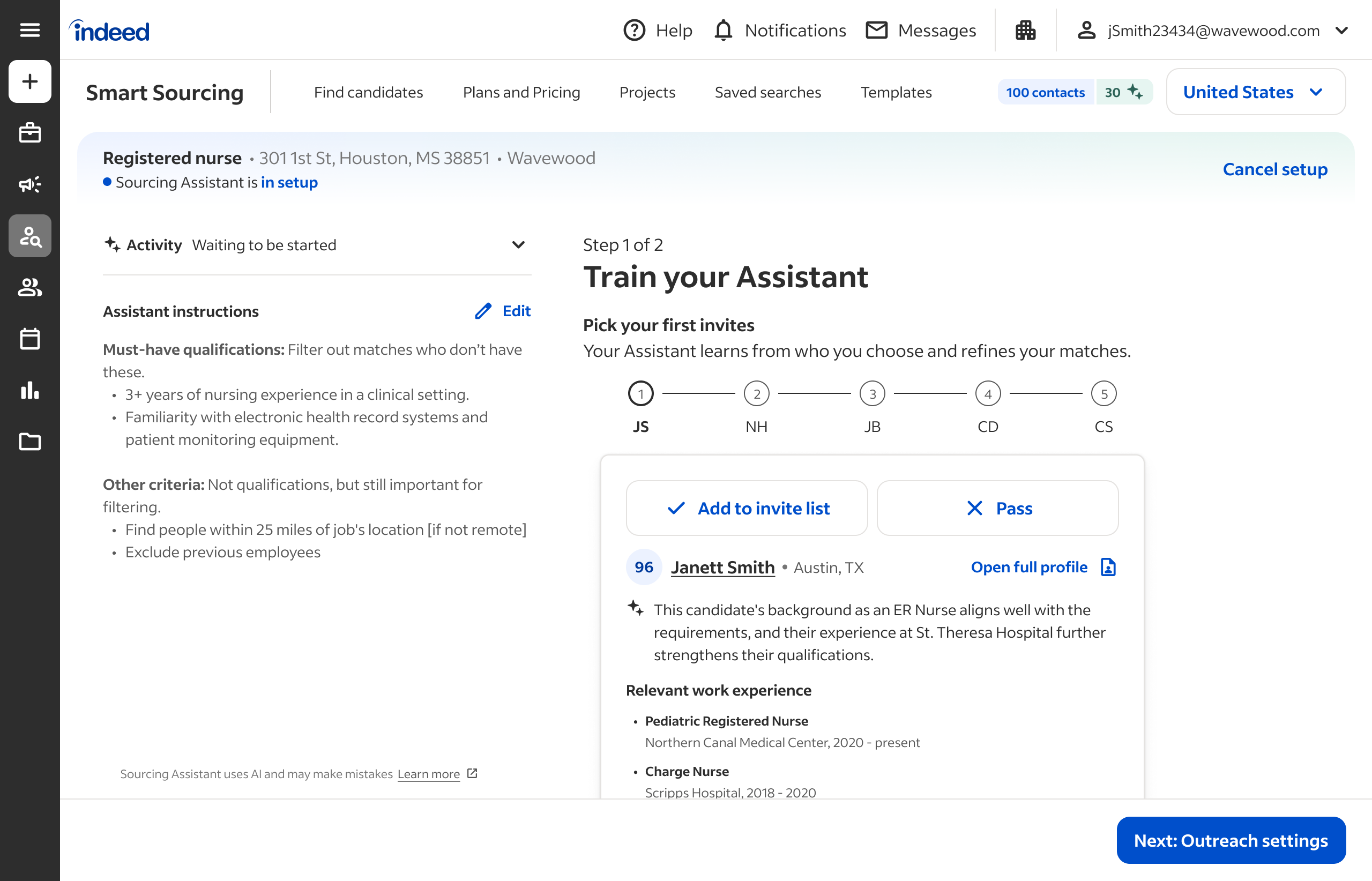
- Shipped: Skip the instruction review step and play it back in a sidebar on the candidate calibration step where users could still view and edit them.
Candidate calibration: adding good friction
With intent collection now passive, reviewing candidates carried the load of refining intent. Presenting those candidates as the first outreach batch connected the user's effort to hiring progress. They weren't training an agent, they were recruiting top talent.
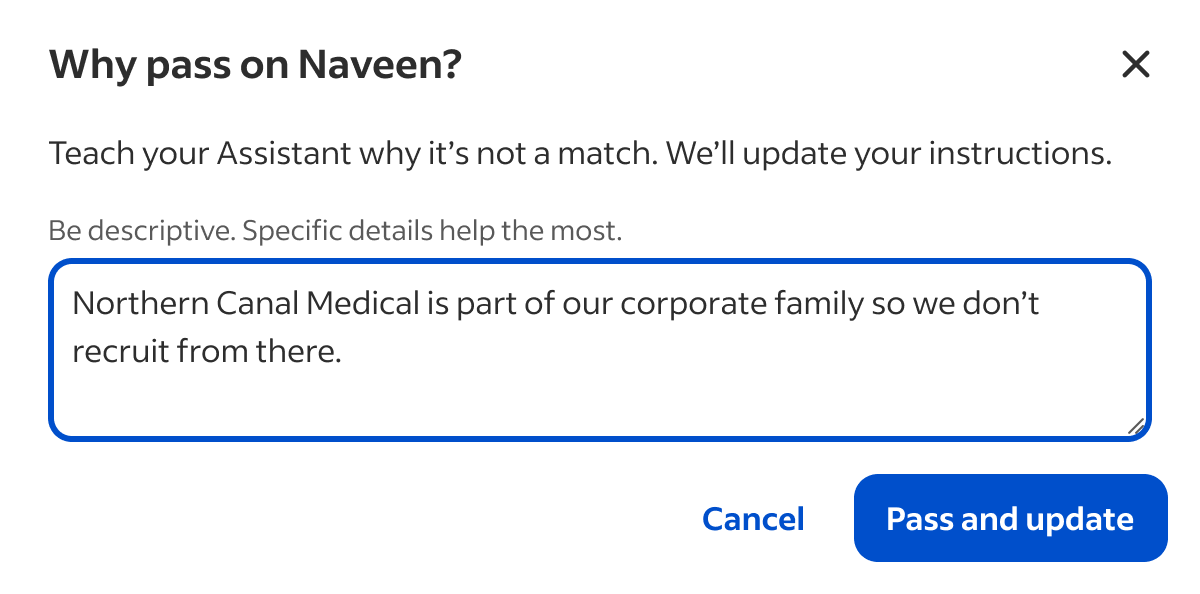
Rejection was our strongest signal of miscalibration. Having users explain a rejection provoked honest intent the agent metabolized into instructions in the background.
- Tried: reviewing one resume at a time. This was too much detail too early. Activation suffered.
- Tried: approve or revise a card of five candidates. Users spent too long perfecting this card. Activation suffered.
- Shipped: A stepped wizard to review five candidate summaries with a simple keep or pass decision.
Settings as a contract
Surveys and interviews showed us lack of control is the number one reason employers reject AI features from Indeed. Settings is where the agent makes agreement explicit.
- Tried: a setting review screen with each agent parameter exposed, including outreach limits, message tone, and sender information. This was both too much information, and not concrete enough for users to engage. Most people approved it and then expressed surprise later when they saw the result.
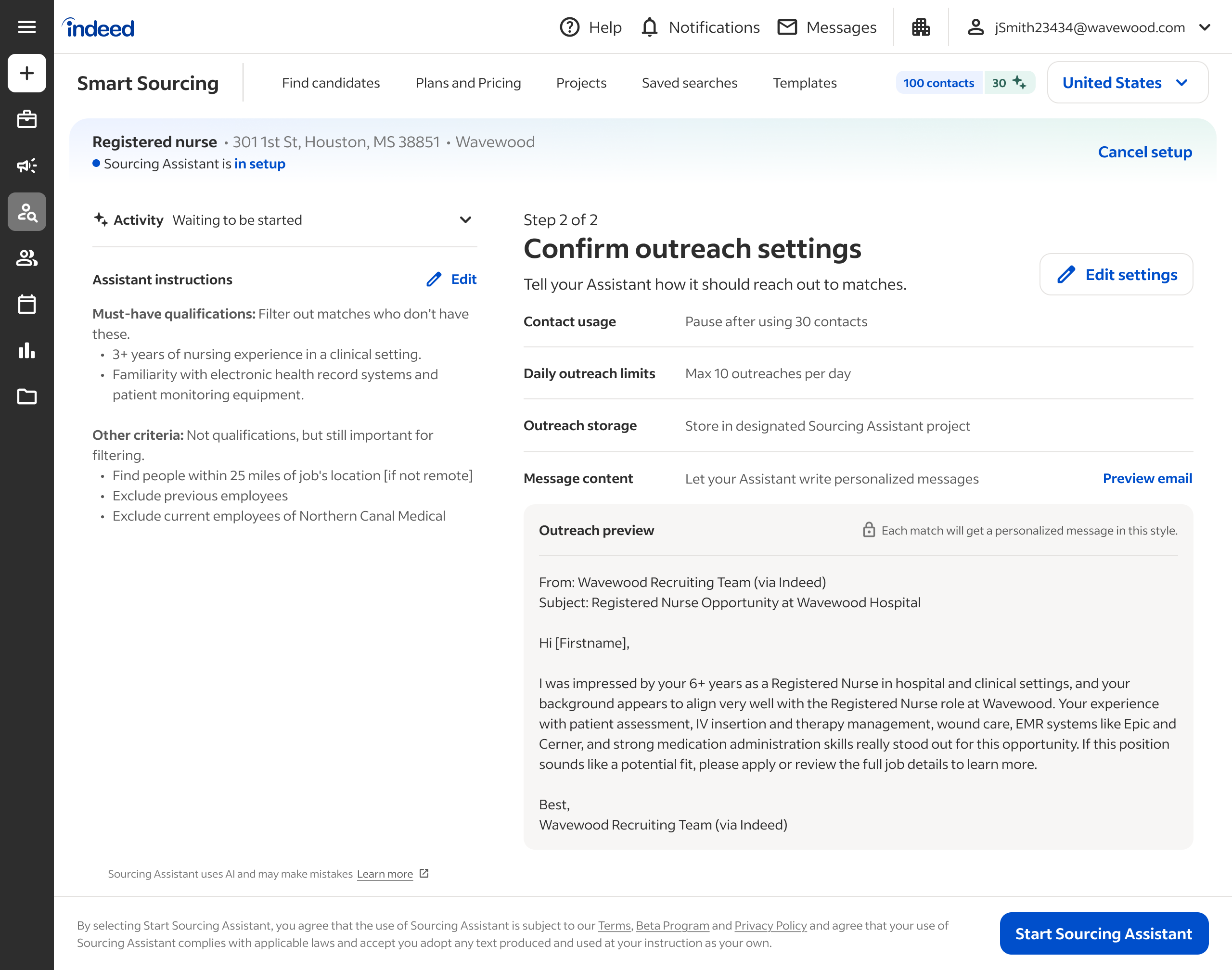
- Shipped: setting presented as a contract and message preview to be approved or refined. Users leaned forward with interest to see what the job seeker would see.
Activity feed: our proof of labor
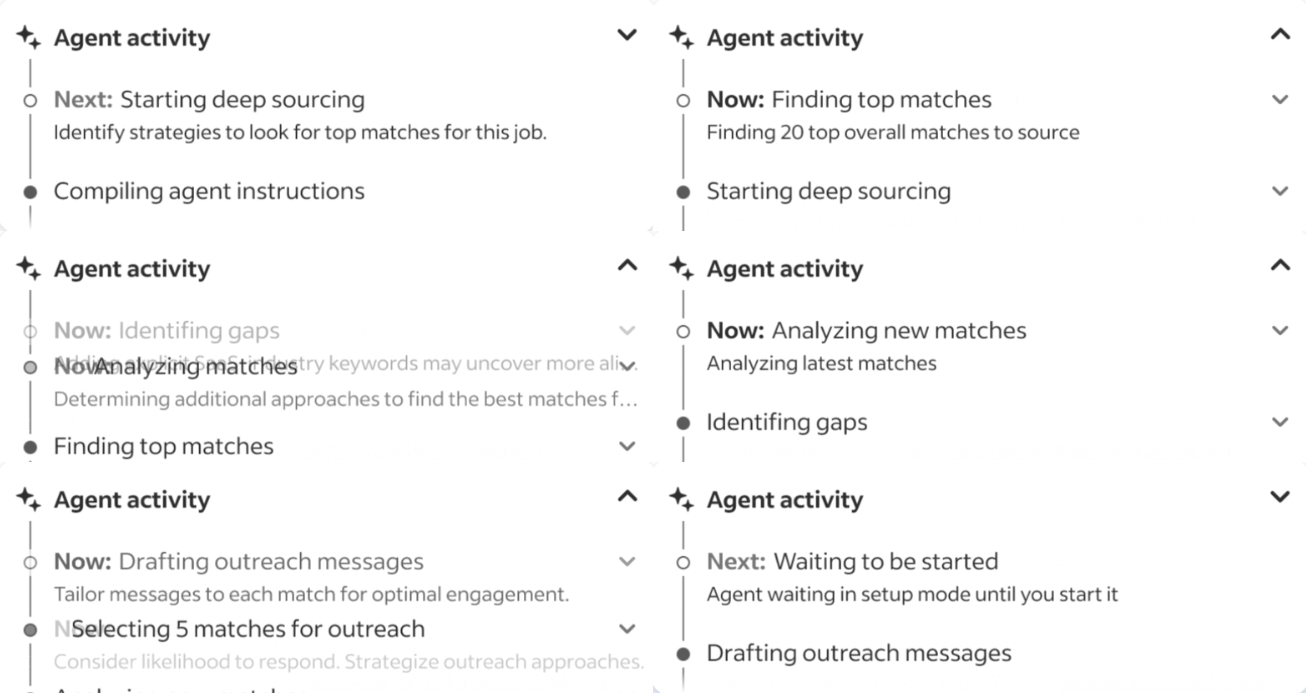
The feed communicates what the agent understands, does, and plans to do.
- Tried: free running feed updating throughout the setup process. Users liked seeing the agent's work because it communicates value, but it distracted them from the activation steps.
- Shipped: a collapsed porthole view of what the agent is currently doing, with the ability to expand for more details and history.
"[Chad] didn't just hand engineers a spec. He sat down with stakeholders across disciplines to understand constraints and tradeoffs before converging on an approach. That willingness to listen before deciding meant the designs we built against were grounded in real technical and customer context, not assumptions." — Senior Engineering Manager
Epilogue and impact
From beta to GA we reduced activation dropoff by 17 points without harming match quality or satisfaction scores.
After testing the sourcing agent in three different packages, we shipped it for general availability as Sourcing Assistant in a new Pro tier of Smart Sourcing, Indeed's enterprise resume search product.
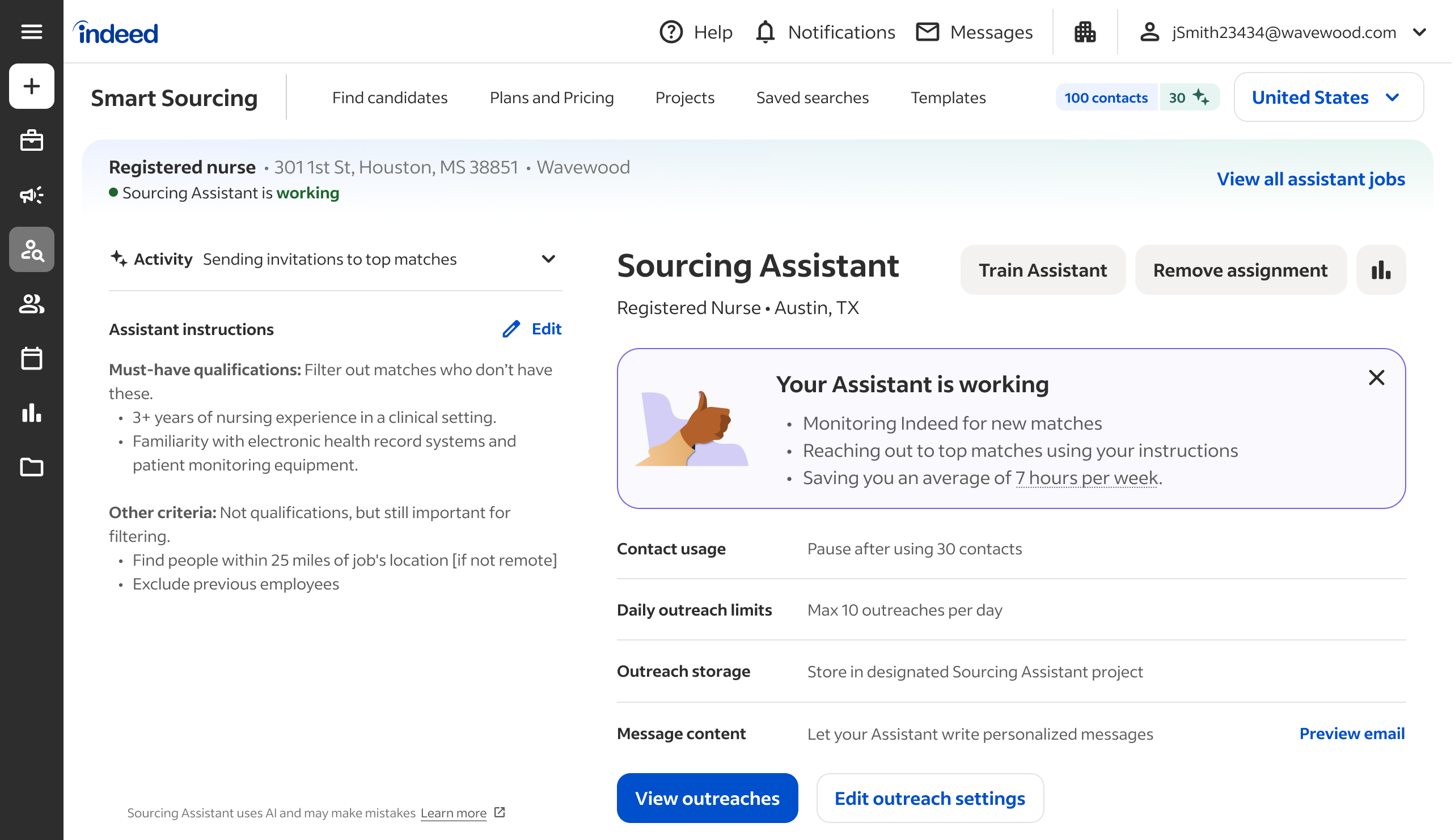
I stayed on through GA's ramp to 100% in April 2026. When the new product was publicly announced in June, Indeed cited three public claims for Sourcing Assistant:
2.9x
More likely to be hired
6 days
Faster to close roles
7 hours
Saved per week
Unresolved: What's the role of autonomy in matching?
Matching humans to other humans remains unsolved. In the real world, employers adjust their ideal as hiring proceeds. An autonomous agent doesn't wait for that to settle. It takes the definition it was handed and acts on it at scale. While most automation gets to be wrong quietly, sourcing is wrong out loud in a stranger's inbox.
I'd still ship an autonomous product because autonomy earns its keep in a lot of this workflow. I shipped the version that went all the way to contact. If I started again from the assumption that matching is unsolved, I think I'd draw that line somewhere else.